
Shopping Cart
- Willy L.J.
- CockpitDekor News
- 0 likes
- 305 views
- 0 comments
- dashboard trim, interior styling, 3D domed trim, buyer guide
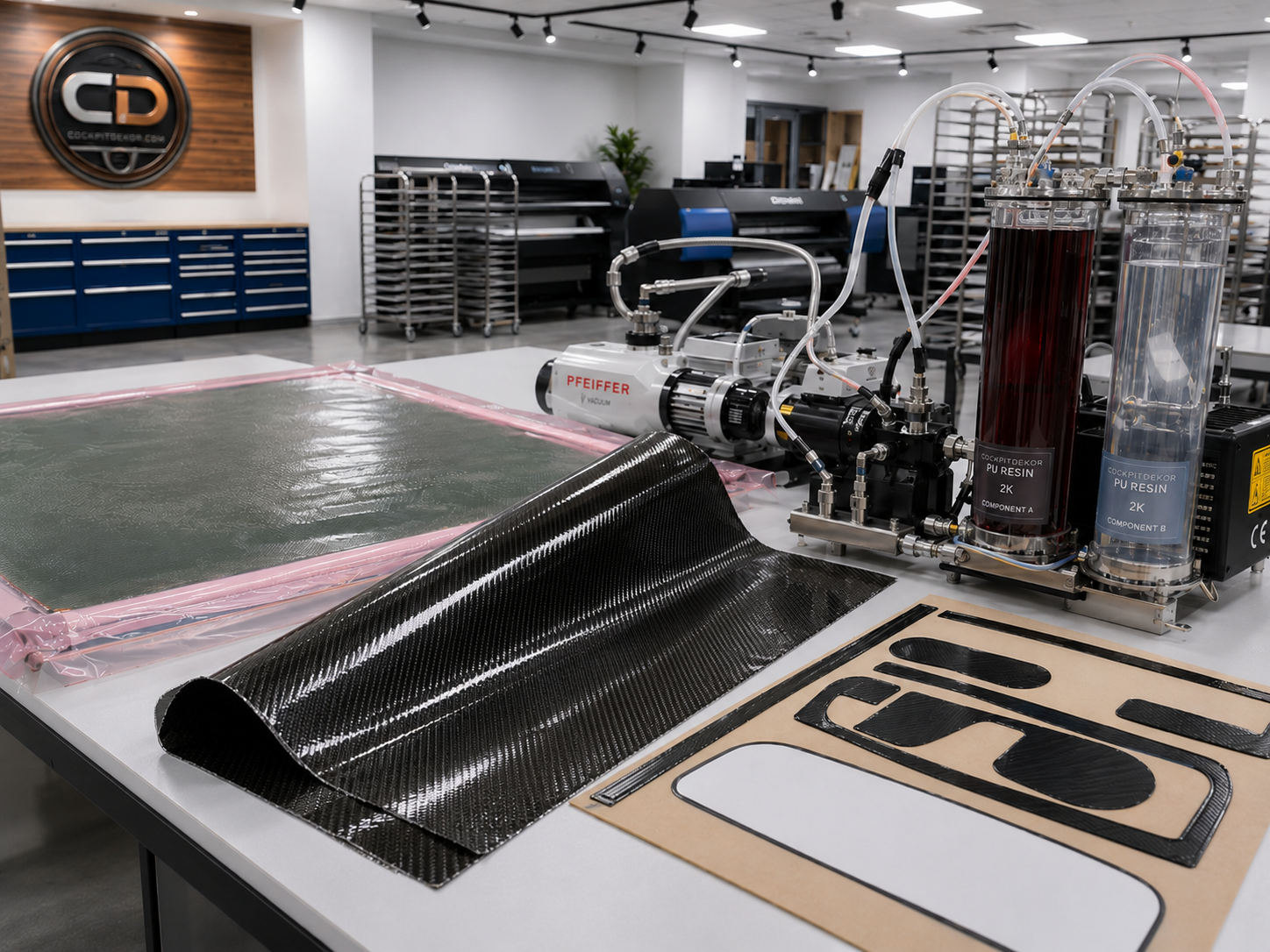
Know-how article: this guide explains our production concept for flexible carbon fiber sheets, resin infusion, UV-heated glass table processing and controlled dispensing/mixing technology used for automotive decorative trim production.
Flexible carbon fiber sheets are an important material for modern automotive interior trim production. They combine the visual depth of real carbon fiber with the practical flexibility required for dashboard trim kits, center console overlays, door trim accents, switch surrounds, decorative panels and custom interior components.
At CockpitDekor / AutoDekor, we use controlled production methods to create flexible carbon fiber sheets in practical working formats such as 500 × 700 mm. This size is suitable for efficient cutting, nesting and later conversion into vehicle-specific decorative parts.
1. What Flexible Carbon Fiber Sheets Are
A flexible carbon fiber sheet is a decorative composite surface made with carbon fiber fabric, resin and a controlled curing process. Unlike rigid structural carbon parts, these sheets are designed mainly for decorative automotive interior use.
The goal is not to create a structural vehicle component. The goal is to create a stable, attractive and workable carbon fiber surface that can later be cut, shaped and used for interior trim applications.
- dashboard trim overlays
- center console decorative panels
- door trim inserts
- window switch surrounds
- custom interior styling parts
- small carbon-look decorative components
- prototype and training samples
2. Why 500 × 700 mm Is A Practical Production Format
The 500 × 700 mm sheet size gives a good balance between material economy, handling, curing control and later cutting efficiency. It is large enough to produce multiple trim parts from one sheet, but still compact enough for controlled workshop processing.
For vehicle interior trim production, this format allows better planning of material use. Parts can be nested together before cutting to reduce waste and improve production economy.
| Production Factor | Benefit Of 500 × 700 mm Format |
|---|---|
| Handling | Easy to move, inspect, store and process manually. |
| Cutting economy | Several trim parts can be nested on one sheet with reduced waste. |
| Quality control | Surface defects are easier to detect before cutting. |
| Workshop space | Fits compact production tables and curing areas. |
| Small series production | Suitable for short runs, samples, custom jobs and vehicle-specific kits. |
3. Infusion On A UV-Heated Glass Table
One of the most important parts of the process is the controlled resin infusion and curing surface. A flat glass table provides the required surface stability, visibility and cleanliness. When combined with UV or controlled heating, it helps stabilise resin flow, curing speed and final surface quality.
The heated glass table helps keep the resin at a more consistent working condition. This is important because resin viscosity, flow, air release and curing behaviour are strongly influenced by temperature.
- stable flat working surface
- better resin flow control
- reduced risk of uneven cure
- improved surface finish
- cleaner inspection during production
- better repeatability between sheets
The glass table also makes it easier to identify air pockets, dry areas, contamination and edge-flow problems before the sheet moves to the next production stage.
4. Resin Flow Control During Infusion
Good carbon fiber sheet production depends on controlled resin movement. Too much resin creates unnecessary weight, surface distortion and waste. Too little resin may leave dry areas, poor bonding or an uneven finish.
Flow control means managing how resin enters the carbon fiber structure, how it spreads across the sheet and how excess material is avoided. This is where table temperature, resin viscosity, dosing quantity, fabric position and vacuum or pressure conditions all work together.
| Flow Issue | Possible Cause | Control Method |
|---|---|---|
| Dry carbon areas | Insufficient resin, poor distribution or fast cure | Improve dosing plan, resin path and temperature control. |
| Excess resin | Overdosing or poor evacuation of surplus material | Use measured dosing and controlled flow channels. |
| Air bubbles | Fast mixing, trapped air or unsuitable resin viscosity | Control mixing speed, use proper degassing and stable temperature. |
| Uneven finish | Unlevel table, inconsistent heat or fabric movement | Level the glass table and fix the material position before infusion. |
| Slow impregnation | High viscosity or low temperature | Use correct working temperature and compatible resin system. |
5. Our Infusion Dispensing And Mixing Machine
Manual resin preparation can be useful for testing and small batches, but repeatable production requires controlled dosing and mixing. Our infusion dispensing and mixing machine is designed to support stable resin preparation, controlled component ratio and economical material use.
The system can be used to prepare two-component resin materials with more consistency than hand mixing. It helps the operator control the resin quantity, flow rate and mixing quality before the material reaches the carbon fiber sheet.
- controlled resin and hardener dosing
- repeatable mixing ratio
- adjustable material flow
- reduced manual measuring errors
- better process economy
- more stable production quality
- less unnecessary resin waste
6. Economy: Why Controlled Dosing Matters
Resin is one of the most important cost factors in flexible carbon sheet production. Poor dosing leads to waste, rework and inconsistent results. A controlled dispensing system helps reduce these problems.
Material economy is not only about using less resin. It is about using the correct amount of resin in the correct place at the correct time. This improves both cost control and surface quality.
| Production Area | How Controlled Dosing Helps |
|---|---|
| Resin consumption | Reduces unnecessary over-application. |
| Waste reduction | Less mixed material is thrown away after pot life expires. |
| Batch consistency | Sheets are produced with more repeatable resin content. |
| Defect prevention | Lower risk of soft cure, bubbles, dry areas and excess resin pools. |
| Production planning | Operators can calculate material use more accurately per sheet. |
7. Manual Vs Machine-Controlled Resin Preparation
Both manual and machine-controlled resin preparation have their place in production. Manual work is useful for experiments, training and low-volume tasks. Machine-controlled mixing is better for repeatable results, cost control and stable sheet quality.
| Topic | Manual Mixing | Dispensing / Mixing Machine |
|---|---|---|
| Best use | Testing, samples, small jobs | Repeatable production and controlled batches |
| Ratio accuracy | Depends on operator measurement | Controlled by the machine setup |
| Material economy | Higher risk of waste | Better control of resin consumption |
| Flow control | Operator-dependent | Adjustable and repeatable |
| Training requirement | Basic measuring and mixing discipline | Machine setup, calibration and process control |
| Quality stability | Can vary between batches | More consistent when correctly configured |
8. From Flexible Sheet To Automotive Trim Part
After the carbon fiber sheet is produced and cured, it can be used as a base material for decorative automotive parts. The sheet may be cut into shapes for dashboard trim kits, center console panels, door inserts or smaller interior details.
The 500 × 700 mm format is especially useful because it allows multiple parts to be arranged efficiently before cutting. This supports better material yield and lower waste during production.
- sheet inspection
- material nesting
- cutting or routing
- edge finishing
- adhesive preparation
- final quality control
- packing for vehicle-specific kits
9. Quality Points We Control
A flexible carbon fiber sheet must look good, remain stable and be suitable for later processing. This requires control at every stage of production.
- carbon fiber alignment
- resin ratio
- resin quantity
- flow direction
- temperature of the glass table
- surface cleanliness
- curing time
- final gloss and surface depth
- flexibility after cure
- cutting compatibility
10. Safety And Process Documentation
Resin systems must always be handled according to the supplier’s Safety Data Sheet, technical data sheet and local workplace safety rules. Operators should use suitable gloves, eye protection, ventilation and clean working procedures.
Process documentation is also important. For repeatable production, it is useful to record material batch numbers, mixing ratio, table temperature, working time, curing time, sheet size, defects and final inspection results.
Safety note: this article is educational information only. It does not replace resin supplier documentation, SDS review, workplace safety training, local regulations or professional chemical-handling procedures.
11. Why This Know-How Matters
Flexible carbon fiber sheet production is not only about appearance. It is about repeatability, economy and process stability. Controlled infusion, a stable heated glass table and a precise dispensing/mixing system help create a better working material for automotive interior trim production.
For CockpitDekor / AutoDekor, this know-how supports the development of decorative carbon fiber trim parts, prototype interior components and future material options for vehicle-specific styling kits.
12. About CockpitDekor / AutoDekor
CockpitDekor / AutoDekor manufactures vehicle-specific automotive interior trim components, dashboard trim kits and decorative 3D domed parts. Our production experience includes real wood veneer, carbon fiber finishes, brushed aluminium, piano black surfaces, PU resin doming, cutting templates and custom interior styling materials.
We continue to develop practical production methods for small series, custom jobs and vehicle-specific decorative trim kits for cars, vans, trucks, motorhomes and special applications.

Comments (0)